
Board meeting minutes & agenda template
A committee doesn't need formal paperwork to run well - it needs a simple agenda that keeps the meeting on track and minutes short enough that decisions actually stick. Here are both, ready to copy.
Most committees don't fall apart in a dramatic row. They fall apart quietly, in the gap between meetings, because nobody wrote down what was decided and so three weeks later half the committee remembers it one way and half remembers it another, and the whole thing gets re-argued from scratch at the next meeting. An agenda and a set of minutes sound like the boring, bureaucratic part of running a community group - the paperwork you put up with rather than the work itself - but they're actually the thing that stops you having the same conversation every month for a year. Get those two little documents right and a surprising amount of the friction just goes away.
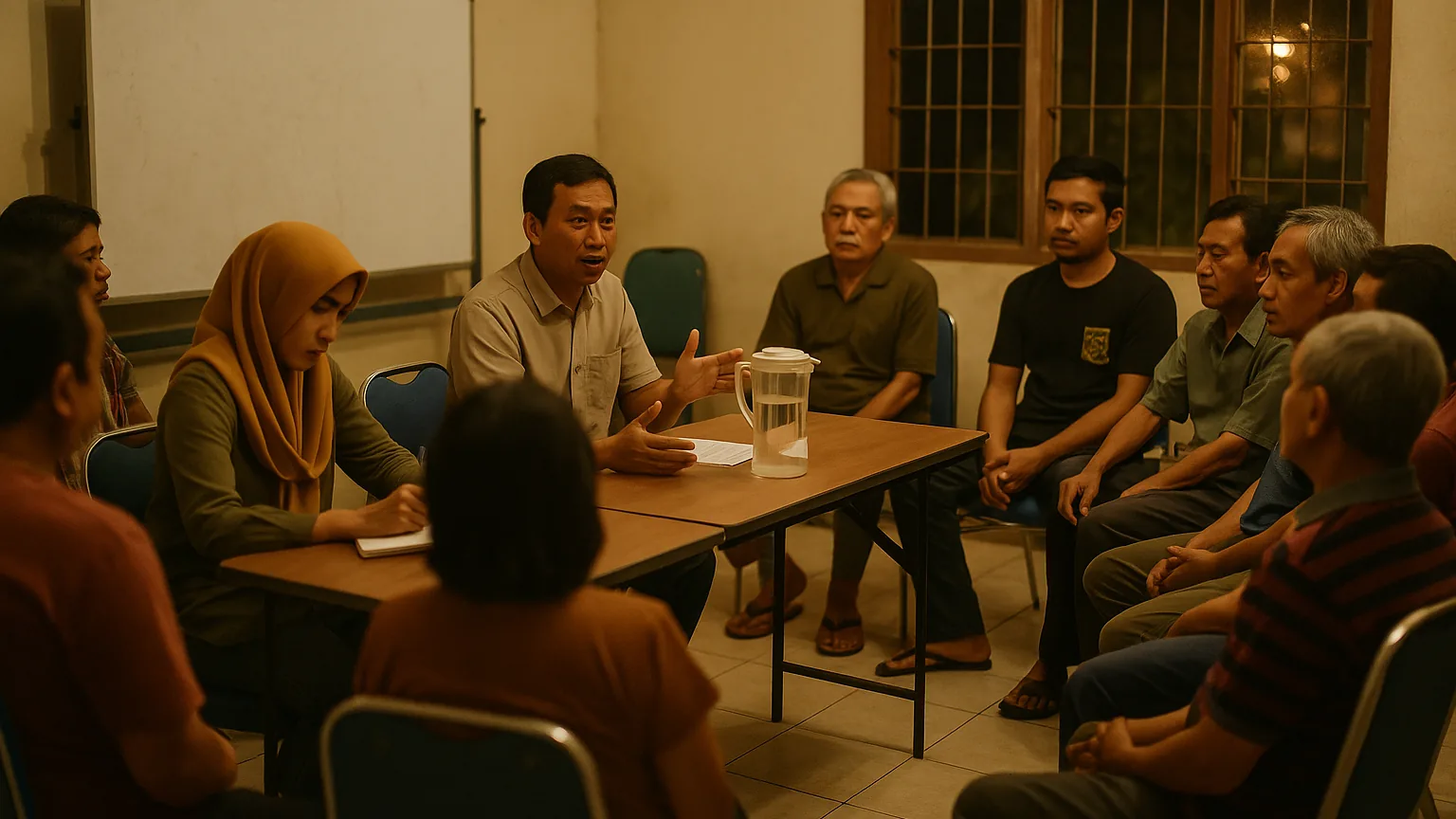
Let me carry one example through so this doesn't stay abstract. Say you're on the committee of the Paguyuban Warga Kampung Melati, the residents' association for RW 08 - around 130 households, a monthly rapat warga in the balai, an iuran of somewhere between Rp 25.000 and Rp 50.000 a month per household, and the usual run of things a neighbourhood committee deals with: the ronda roster, kerja bakti, the drainage that floods when it rains hard, the 17 Agustusan budget, and the occasional grumble about parking. There's a ketua (Pak Bandi), a sekretaris who takes the notes (Bu Sri), a bendahara (Pak Yusuf), and a handful of seksi leads for keamanan, kebersihan and kegiatan. Nine people, once a month, an hour and a bit. That's the group we're trying to keep sane.
Why the agenda matters more than it looks
An agenda does two quiet jobs. The first is obvious: it tells everyone what the meeting is for, so people turn up having thought about the right things rather than being ambushed on the night. The second is less obvious but arguably more important - it stops the meeting sprawling. Without one, a rapat warga about the drainage and the 17-an budget somehow becomes an hour on who left their motorbike blocking Gang 3, and the two things you actually needed to decide never get decided. The agenda is the polite way of saying "we'll get to that, but not now", and having it written down means it's the paper doing the disciplining, not you having to be the person who cuts everyone off.
It doesn't need to be elaborate. A residents' committee is not a listed company, and a page of formal "matters arising, sub-clause 4(b)" language would just make everyone's eyes glaze over. Six headings is plenty. Send it round two or three days before on the WhatsApp grup so people have a chance to read it (nobody reads it, but sending it still helps - it sets expectations, and the one or two who do read it will come prepared). Then follow it on the night, roughly. Roughly is fine. The agenda is a guide, not a straitjacket.
A plain agenda template you can reuse
Here's the whole thing. Copy it, change the names, use it every month:
- Welcome and apologies. Who's here, who sent word they couldn't make it. Thirty seconds. It also quietly tells you whether you've got enough people present to actually decide anything, which matters more than it sounds - if your rules say a decision needs a certain number of committee members present, this is where you find out you're short. (Worth checking what your own rules actually say on that - it's the kind of thing that lives in your bylaws or AD/ART, and most committees have never read their own.)
- Minutes of the last meeting. A quick "does everyone agree this is what we decided last time?" Not a re-reading of the whole thing - just a chance to correct anything that's wrong before it becomes the official record. This single item is what stops the endless re-arguing.
- Reports. Short updates from the people who owe them. For Kampung Melati that's three: the treasurer (what's in the kas, how the iuran collection is going, anything unusual), membership (new families who've moved in, anyone who's left, the contact list), and events or activities (what's coming up, how the last one went). Two or three minutes each. If a report needs a decision, that decision goes further down the agenda, not here - reports are for information, not for opening debates.
- Main items for decision. This is the heart of the meeting and it should have the most time. List the actual things that need deciding, phrased as decisions - "agree the 17 Agustusan budget", "decide whether to extend the portal closing time", "approve fixing the got by the musholla" - not vague topics like "security" or "the drains", which go nowhere. One line each. Three or four is a healthy meeting; if you've got eleven, some of them aren't really decisions and some should wait.
- Any other business. The catch-all for the thing someone remembered on the way in. Keep it genuinely small - if something big surfaces here, the honest move is usually to park it and put it as a proper decision item next month, when people have had time to think, rather than deciding something that matters in the last five minutes when everyone wants to go home.
- Next meeting. Date, time, place. Agree it before anyone leaves the room. Chasing nine people over WhatsApp to find a date that suits everyone is its own small misery, and you can skip the whole thing by just settling it while they're all sitting there.
One habit worth forming: write the agenda straight off the back of last month's action items. If you decided in June that Pak Dedi would get three quotes for the CCTV, then "CCTV quotes - update from Pak Dedi" writes itself onto the July agenda. Do this and the agenda stops being a thing you invent from scratch each month and becomes a simple continuation of what you already agreed - which is exactly what it should be.
Minutes: shorter than you think
Most people get minutes wrong in the same direction, and I say this as someone who has read some truly heroic examples of over-documentation: minutes are not a transcript. You are not a court stenographer. Nobody, ever, needs to know that Pak Yusuf said the kas was looking healthy and then Bu Wati said she agreed and then there was a discussion about whether to buy new tents. All of that talking is the meeting doing its job, and almost none of it needs to survive the meeting. What needs to survive is small and specific: what did we decide, and who's doing what by when. That's it. If you can capture those two things reliably, your minutes are good, however scrappy they look.
The trap is thinking that longer minutes are more thorough and therefore better. They're not - they're worse, because the two things that actually matter get buried in a wall of he-said-she-said that nobody will ever read. A good set of minutes for a residents' committee is often half a page. You should be able to skim it in a minute and know exactly what was agreed and what you personally are on the hook for. If yours run to three pages of narrative, you're doing more work to produce something less useful, which is a rare double loss.
A minutes template to match
Mirror the agenda, then add the two bits that do the real work - the decisions and the actions:
- Basics. Date, time, place. One line.
- Present and apologies. Who was there, who sent apologies. This isn't just politeness - if a decision is ever questioned later, "these seven people were present and agreed it" is the record that settles it.
- Against each agenda item, a line or two. Not what was said - just where it landed. "Treasurer reported kas at Rp 4.2 juta, iuran collection at about 80% for the month." Done. Move on.
- Decisions, listed clearly. Pull every actual decision out into its own short list so it's impossible to miss. "Agreed: 17 Agustusan budget of Rp 4 juta." "Agreed: portal to close at 23.00 on weeknights, trial for one month." Phrase them as settled facts, because that's what they now are.
- Action items - the most important part. Every action gets three things: what, who, and by when. "Pak Dedi to get three CCTV quotes before the next meeting." "Bu Wati to book the tents for the 17-an by the end of July." An action without an owner is a wish, and an action without a date is a someday, and someday is where good intentions go to quietly die. Naming the person and the date is the single highest-value thing minutes do.
- Next meeting. Date, time, place, copied from the agenda.
The reason the action list earns its keep is that it's also next month's agenda, half-written, and it's the thing you read out near the start of the next meeting to check what's been done. That loop - decide, write it as an action with a name and a date, follow it up next time - is most of what separates a committee that slowly gets things done from one that has the same discussion about the drainage for two years running. It's not clever. It's just written down, and followed up.
A quick word on who owns what, because it comes up. The reports and the actions both assume everyone knows their patch - that the bendahara handles the money, the keamanan lead handles the ronda and the portal, and so on. If that's fuzzy on your committee, the minutes will keep landing actions on "someone" and "someone" never does them. Sorting out who's responsible for what is worth doing properly, and it's a slightly different job from this one - I've written separately about committee roles and who does what, which pairs naturally with getting your minutes to stick.
The small honesties that make it work
A few things I'd gently insist on, all learned the boring way. Write the minutes on the night or the morning after, not a week later - by day three you genuinely won't remember whether the budget was Rp 4 juta or Rp 4.5 juta, and a vague minute is worse than none because people trust it. Send them round within a day or two while the meeting's still fresh, so corrections come while people can still remember. Keep them all in one place - a shared folder, a pinned message, a simple book that lives with the sekretaris - so that when someone asks in November "hang on, what did we actually agree about the parking?", the answer takes ten seconds to find rather than being lost to memory and mood.
And don't gold-plate it. You do not need formal motions and seconders and a vote count for a neighbourhood committee deciding on tent hire - that's borrowing the costume of a formal AGM for a meeting that doesn't need it. Save the full formality for the once-a-year gathering where it genuinely matters, and keep the monthly rapat light. Start rough, too. A half-page of decisions and actions, typed into the WhatsApp grup right after the meeting, beats a beautiful formatted document you're too tired to ever actually produce….
If you take one thing away: the agenda keeps the meeting from sprawling, and the minutes keep the decisions from evaporating. Between them they answer the only two questions that matter afterwards - what did we agree, and who's doing what - and everything else you might be tempted to record is just noise you'll never read.
Keeping the agenda, the minutes and the follow-up actions all joined up is a fair bit of what Anggota is built to make less of a chore - somewhere the committee's decisions and action items live together instead of scattered across chat threads and someone's notebook, so the person taking over as sekretaris next year isn't starting from nothing. If that sounds useful you're welcome to try it for free and see how it fits your committee. And if you'd rather run all of this out of a shared doc and a WhatsApp grup, that's genuinely fine - the templates above work whatever you keep them in, and a committee that writes down its decisions and chases its actions will run better than one that doesn't, no matter what tool it uses to do it.