

How to write your organisation's bylaws (with a template)
Bylaws are the boring hour you spend while everyone's still friends, so nobody has to argue the rules out from scratch later. Here's what they are, why even a small club benefits, and a plain skeleton you can fill in.

Bylaws are one of those documents nobody reads until the afternoon two people remember the same rule differently, and by then it's too late to write them calmly. Somebody wants to stand for the committee, half the room is sure you have to have been a member for a year first, the other half swears it's six months, and nobody can point to anywhere that actually says. That's the moment you wish you'd spent an hour, back when everyone was still on good terms, agreeing the boring stuff in writing. Bylaws are just that hour done in advance - a plain set of rules your group agrees to run itself by, so the answer to "are we allowed to do this?" is written down somewhere rather than argued out from scratch every single time.
They go by a few names. In English you'll hear bylaws, constitution, rules, or a governing document, and they all point at roughly the same thing. In Indonesia the usual shape is AD/ART - Anggaran Dasar and Anggaran Rumah Tangga - and the split between the two is genuinely worth understanding, even if you never file anything formally. The Anggaran Dasar is the big, slow-to-change stuff: who you are, what you exist for, how the organisation is fundamentally put together. The Anggaran Rumah Tangga is the household rules - the day-to-day detail, the dues amounts, the meeting procedures, the things you'll adjust more often. Keeping the two apart means you can change a fee without reopening the whole constitution, which saves you no end of bother down the track.
I'll carry one example all the way through so none of this stays abstract. Picture Koperasi Rukun Makmur - a neighbourhood cooperative of maybe 60 - 80 members, mostly warung owners and a few home producers, who pool a small monthly saving, lend each other modest amounts when the school fees all land at once, and a couple of times a year buy cooking oil and rice in bulk so nobody's stuck paying the corner-shop markup. Nothing grand. But the moment money starts changing hands between neighbours you want the rules clear - who can borrow, how much, who decides, what happens if someone stops paying - and that's exactly the job a decent set of bylaws does.
Why even a small club is better off writing some
There's a fair argument that a tiny, informal group doesn't need any of this, and honestly, for the first year or two you can usually muddle along on shared memory and goodwill. I wouldn't push anyone into a twelve-page rulebook they don't need yet. But shared memory has a quiet habit of disagreeing with itself, and goodwill is at its thinnest at exactly the moments the rules matter most - a contested committee spot, a member the group wants to ask to leave, a treasurer and a chairperson who've stopped seeing eye to eye. A page or two written while everyone's calm is worth far more than any amount of arguing after the fact, and it does something subtler too: it makes the group feel real, and it tells a cautious new member that this is a serious outfit that has thought about how it runs.
For something like a koperasi, where there's actual money and actual member savings sitting in the pot, the bylaws stop being optional politeness and become the thing that protects people's contributions. If Rukun Makmur ever has a dispute over a loan that went bad, "what does it say in our rules" is a much better place to start than "what did we all think we agreed two years ago". You don't need it to be long. You do need it to exist. If you're still at the very beginning of all this, it's worth reading how the pieces fit together first - I've written a fuller guide to starting an organisation that sets the scene.
Read this bit before you copy anything: what follows is a practical template to help you think and draft, not legal advice, and I'm not a lawyer. The moment your group holds money, signs contracts, employs anyone, or wants formal legal recognition, the rules that actually bind you are your local ones, not a blog post. In Indonesia the common formal legal forms each come with their own requirements - a perkumpulan (association), a yayasan (foundation), or a koperasi (cooperative, which has its own cooperative law and is usually set up through a notaris) - so check what applies to your situation, and where there's money or liability involved, get a notaris or someone who genuinely knows to look over the real document before you rely on it.
A skeleton you can fill in
Here are the sections a simple set of bylaws usually covers. Treat each one as a prompt rather than a form to complete - a question to answer in your own plain words, a sentence or two each to start with. Don't reach for legal language you don't fully understand; "the committee meets at least four times a year" beats a paragraph of whereases and hereinafters that nobody will ever read. You can always tighten the wording later. Getting a first honest draft down is the hard part, and it's mostly just deciding what you actually want and writing it plainly.
1. Name and purpose
Start with the easy one. What is the organisation called, and what does it exist to do? Two or three sentences is plenty - the official name, where it's based, and a plain statement of purpose that a stranger could read and understand. Rukun Makmur's might be as simple as "a cooperative for the households of RW 04 to save together, lend to one another on fair terms, and buy shared supplies at better prices." Resist the urge to list every possible activity. A clear purpose you'll still recognise in five years is better than an exhaustive one you'll have outgrown by next Ramadan.
2. Membership
This is the biggest section, and it's really four small questions bundled together. Take them one at a time:
- Who can join? Spell out the actual conditions - a resident of the area, over a certain age, introduced by an existing member, whatever genuinely applies. For a koperasi there's usually a joining contribution (the simpanan pokok, paid once) that makes someone a member, so say what it is and when it's due.
- What do members get, and owe? The rights - to attend and vote at meetings, to stand for the committee, to use whatever the group offers. And the obligations, said plainly - turn up, pay on time, don't bring the group into disrepute. Keep it human, not a charge sheet.
- What does membership cost? The dues, how much, how often, and what happens if someone falls behind. Rukun Makmur has a monthly saving (the simpanan wajib) of, say, Rp 40,000 - Rp 60,000; a running club might just have an annual fee. Give the amount, or say where the amount is set, so it's not a mystery.
- How does someone leave, or get asked to leave? The pleasant version (a member resigns, here's what they give notice of, here's what happens to any savings they've built up) and the unpleasant one (the grounds for removing a member, and who decides, ideally not one person acting alone). You will hope never to use the second half. Write it anyway, while it's abstract and nobody's angry.
3. The committee, and who does what
Who actually runs the thing between meetings? Name the roles and say, in a line each, what they're responsible for. Most groups land on a chairperson, a secretary, and a treasurer as the core - a koperasi calls this the Pengurus, and cooperatives usually also have a Pengawas, a small supervisory group of two or three whose only job is to keep an honest eye on the money and the management. That separation is a good idea well beyond cooperatives, frankly. Say how people get into these roles (elected by the members, and for how long - a one or two year term is common), and how many committee members there should be. If you want the detail on what each role actually involves day to day, that's its own topic - see board roles and responsibilities.
4. Meetings and voting
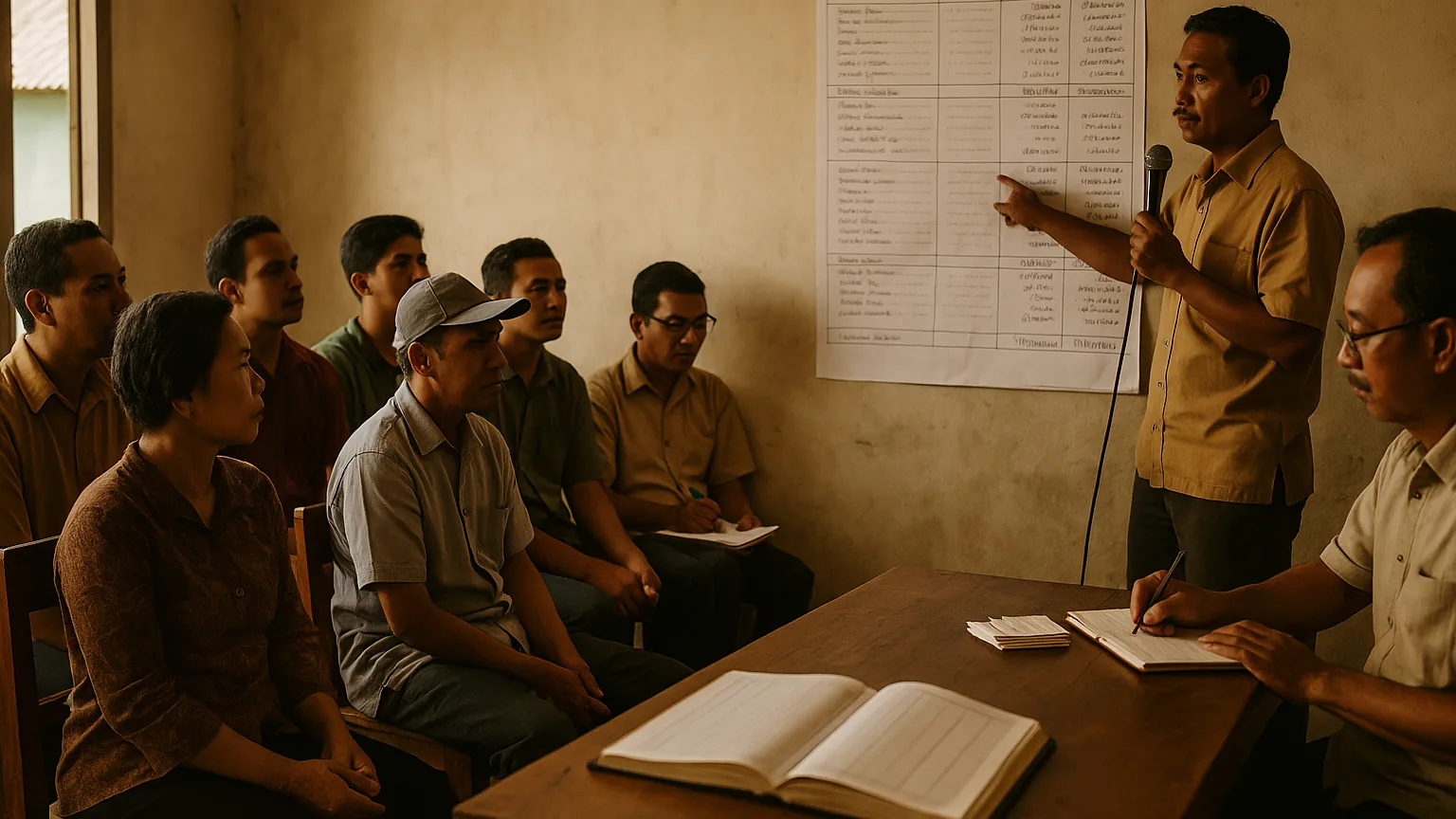
How does the group make decisions together? Cover the regular meetings (how often the committee meets) and the big one - the annual members' meeting, which for a koperasi is the Rapat Anggota Tahunan and is genuinely the highest authority in the organisation, above the committee. Then the voting rules, and this is where a little care up front saves a lot of grief: who gets a vote (usually one per member), how many people need to be present for a decision to count (the quorum), and whether a plain majority carries it or some decisions need more. Don't over-engineer it. A simple, clear rule everyone understands beats a clever one only the secretary can follow.
5. Money and finances
Where does the money come from, where can it go, and who watches it? You don't need accounting standards in here - just the sensible guardrails. Who can sign off spending, and above what amount does it need a second person or the committee's agreement. When the accounts get presented to members (at least once a year, at that annual meeting). Who holds the bank account. For a koperasi there's an extra piece worth naming: what happens to any surplus at year end - the SHU, sisa hasil usaha - and roughly how it's shared back among members, because that's often the whole reason people joined. Even a two-line version of this section makes it far harder for money to quietly go astray, which protects the honest treasurer as much as anyone.
6. Changing the bylaws
Rules you can never change are rules you'll eventually just ignore, so build in the way to update them. Say who can propose a change, how much notice members get, and what vote it takes to pass - usually a higher bar than an everyday decision, so the core rules can't be rewritten on a quiet Tuesday by whoever happened to show up. This is exactly where the AD/ART split earns its keep: the everyday details in the "household rules" half can be adjusted fairly easily, while the fundamental stuff needs the members properly behind it. Get this section right and the whole document stays alive instead of slowly drifting out of date until nobody trusts it.
7. Winding up
The one nobody wants to write, and the one you'll be glad exists if the day ever comes. If the group decides to close, or simply fades away, what happens to whatever's left - the equipment, the bank balance, the members' savings? For most clubs the answer is that any remaining assets go to a similar not-for-profit group rather than being split as a windfall, but for a koperasi, where members have paid in real savings, there are proper rules about members getting their contributions back, and this is one to check against the actual cooperative law rather than improvise. A short, clear clause here prevents a genuinely miserable argument at the worst possible time.
Using it without turning it into a monster
A few things that keep a set of bylaws useful rather than ornamental. Keep it short - most small groups need two to four pages, not twenty, and every extra clause is one more thing to get wrong or forget. Write it so a new member could actually read it in one sitting and come away knowing how the group works. Put it somewhere everyone can find it, not in the secretary's inbox from three years ago. And glance over it once a year, at that same annual meeting, to check it still matches what you actually do - because the fastest way to make a document worthless is to let reality and the rulebook quietly part company.
Start rougher than you think you're allowed to, as well. A plain one-page version that the members have actually read and agreed to beats a beautiful constitution that's still a draft in someone's head. Write the simple version, use it for a year, and fix the bits that turned out to be unclear or missing….
If you take one thing away: bylaws aren't there to make a small group feel important - they're there for the handful of moments when memory and goodwill run out, and on those days a plain page everyone agreed to in advance is worth more than any amount of good intentions. Write the boring version now, while it's easy.
Once the words are agreed, a fair bit of what the bylaws describe becomes ordinary running - keeping the member list and who's paid up, showing the committee and members' rights in one place, taking dues and recording them, giving members somewhere to actually belong - and that's the day-to-day housekeeping Anggota is built to take off your hands, so the rules on the page match what's happening in real life without a stack of spreadsheets. If that sounds handy you're welcome to try it for free and see how it fits your group. And if you'd rather take this skeleton, fill it in, and run it through whatever you already use, that's genuinely fine - a clear set of rules your members understand and agreed to is worth having however you get there, and the template works the same whatever tool sits behind it.