
How to start a sports club from scratch
A sports club is a regular club plus the awkward physical extras: a pitch you don't own, gear, injuries, and a bill that lands every single week. Here's how to handle the bits that make sport different.

If you've already gone through the plain guide to starting a club, you've got the bones of it - say clearly what it's for, round up a keen few before you build anything, keep the dues small and the maths open, run a warm first session, and then be boringly reliable. A sports club is all of that, and then a handful of extra things a book group or a photography club never has to think about, because sport has a physical reality the others don't. It needs a place to play. It needs a pile of gear. It has bodies that occasionally get hurt. And it usually has a real cost landing every single week over a field you don't own, whether or not enough people turned up to cover it. This piece is about that extra layer - the stuff that's specific to getting a sports club going - so I'll take the general advice as read and spend the whole time on what actually makes sport different.
Let me carry one example through to keep it concrete: Rajawali FC, a tarkam (antar-kampung) football side you're thinking of starting in Depok because there's a decent lapangan ten minutes away, a WhatsApp group of blokes who already kick a ball around most Sundays, and a nagging feeling it could be a proper thing if someone just organised it. Whether you're starting an eleven-a-side football team, a futsal crew, a volleyball club or a basketball side, the shape of the extra work is much the same, so bend the specifics to your own sport as you read….
The pitch comes first, and it's your biggest recurring headache
For most clubs the venue is a nice-to-have you sort out once. For a sports club it's the whole thing, and it's the one cost that never goes away, so it deserves your attention before almost anything else. You broadly have two options, and they trade off against each other in an annoying way. The first is a free or nearly-free community lapangan - the neighbourhood field, a school ground, the bit of grass the RT looks after - which costs you little or nothing (maybe Rp 50,000 - 150,000 a session as a contribution to upkeep or uang kebersihan), but which you don't control. It gets booked out for a wedding, it turns to soup after rain, there are no lights so you're done by six, and half the time someone else's game is already on it. The second is a rented synthetic or mini-soccer pitch, which is reliable, drained, lit, and yours for the slot you've booked - and which costs real money, somewhere around Rp 300,000 - 600,000 an hour in a place like Depok, more under floodlights at night.
My honest steer is that the reliable slot is worth paying for sooner than you'd think, because the single most valuable thing a new club can offer is a session that actually happens at the same time every week. People build their Sunday around a club they can count on, and they quietly give up on one that's on-again-off-again because the field fell through. So even if you start on the free lapangan to keep costs down while you find your feet, treat a locked-in regular slot as the thing you're working towards, not a luxury. Book it as a standing weekly booking if the venue allows it, get to know whoever runs the place, and pay on time - a pitch manager who likes you is worth a surprising amount when two clubs want the same Saturday.

A schedule people can actually build their week around
Once you've got somewhere to play, the next sport-specific job is a rhythm - and the temptation, as with everything, is to do too much. You do not need training twice a week plus a match plus a Saturday fitness session in month one. A single reliable weekly slot is plenty to start, and for a lot of tarkam sides that one session is a kickabout and a small-sided game rolled into one, which is completely fine. Add a second session, or split training from matches, only once the first one is consistently full and people are actually asking for more. For Rajawali that might mean a Sunday-morning session for the first few months, and nothing else, until the habit is set.
When you do start arranging actual fixtures - a friendly here, a game there - give people as much notice as you honestly can, because footballers need to sort out work, family and their own dodgy hamstrings around it. A fixture dropped into the group on Friday night for a Sunday match will get you eight players and a lot of "aduh, can't make it". The same fixture posted two weeks out gets you a full squad and subs on the bench. Announce the regular slot once and protect it fiercely; announce one-off matches early and clearly. That's most of the scheduling battle right there.
Kit and gear - buy the boring stuff, skip the flashy stuff
This is where a lot of new clubs cheerfully waste their first pot of money. The urge is to order matching jerseys with everyone's name and number before you've played a single game, because it feels like being a real club - and it's almost exactly the wrong order to do things in. The gear you actually need on day one is dull: a couple of decent match balls (Rp 150,000 - 300,000 each for something that'll survive a season), a set of bibs or rompi so you can split into teams without everyone owning a strip, a bag of cones, a pump that works, a stocked first-aid kit, and water. That lot will run you maybe Rp 700,000 - 1,200,000 all in, and it's genuinely everything you need to train and play.
Proper jerseys are lovely and they do build a bit of pride, so by all means get them - just later, once the squad has settled into who's actually a regular, and split the cost across the group rather than fronting it yourself. Printed kit tends to run Rp 75,000 - 120,000 a shirt for a decent local job, and there's nothing sadder than a beautiful full set of eighteen shirts when five of the names on them stopped turning up in March. Get the club playing first, order the shirts once it clearly has legs, and you'll spend the money once instead of twice.
Registering players and the safety bit nobody enjoys but everyone should
Keep a proper squad list from early on, and make it slightly more than a hobby club would bother with. For each player you want the obvious stuff - name, position, phone number - plus two things a sports club specifically needs: an emergency contact, and a quick note of anything medical that matters (asthma, a heart condition, a knee that's already gone once). For casual friendlies among your own kampung that list is plenty. If you later join a league or a turnamen you'll need more - a formally registered squad, sometimes KTP or photos, occasionally proof of age for youth or veteran categories - but don't build that machinery until a competition actually asks you for it.
Now the safety part, and I'll be straight with you because most guides go quiet here: the large majority of tarkam sides run with no insurance at all, and football is a contact sport where people roll ankles, pull muscles, clash heads, and once in a while do something properly nasty. Pretending otherwise helps nobody. You don't need a corporate insurance policy to start a kampung team, but you do need a basic duty of care, and it's cheap. Keep that first-aid kit stocked and actually in the bag on match day. Make sure at least one person knows basic first aid - how to handle a sprain, when a knock to the head means you stop, and when something is beyond you and needs a clinic. Know where the nearest klinik or puskesmas is before you need it, not during. Walk the pitch for holes, glass and sprinkler heads before kickoff. Insist on a warm-up even when everyone's keen to just play. And it's worth checking whether your players have BPJS Kesehatan active, because a serious injury is a lot less frightening for a family when the hospital side of it is covered.
A small thing that saves a lot of grief: ring-fence a little of the kas as an injury or emergency fund from the very start - even Rp 20,000 - 30,000 a head set aside once - so that if someone does get hurt, the club can help with a clinic visit or a taxi without anyone having to pass a hat around in a panic. It almost never gets used, and the one time it does, it's the difference between a club that looks after its own and one that doesn't.
Subs have to cover the pitch, week in and week out
Here's the money difference that changes everything about how a sports club handles subs. A book club or a hobby group can run free for months, because it barely costs anything to exist. Your club has a hard, recurring bill - the pitch - landing whether or not enough people showed up, so the subs aren't really about perks or membership benefits. They exist first and foremost to make sure the pitch gets paid for, and that reframes the whole thing. Let me show the maths on Rajawali, because being open about the sum is what keeps everyone comfortable paying it. Say the pitch is Rp 500,000 for your weekly ninety minutes and fifteen to eighteen players usually turn up. That's about Rp 28,000 - 33,000 a head just to cover the field, and once you add a little for balls, the odd repair and that injury fund, you're realistically at Rp 35,000 - 50,000 a session, or monthly subs somewhere around Rp 120,000 - 180,000.
You've got two honest ways to collect it, and they suit different stages. Pay-per-session (iuran tiap main) is the fairest while attendance is bouncing around, because people only pay for the weeks they play - but it puts you in the miserable position of covering the shortfall yourself the week only ten show up and the pitch still costs five hundred. Monthly subs fix that, because the money's in the kas whether or not everyone made it, which is exactly what a fixed weekly pitch bill needs - but they only feel fair once you've got a settled core who genuinely turn up most weeks. My steer is to start pay-per-session while the squad's forming, then move to monthly subs the moment you've got a reliable dozen or more, because the pitch manager wants paying either way and monthly is the model that reliably covers him. Keep the kas visible - a running total anyone can see - and if you get to the point of setting proper monthly or annual subs and want to think the number through properly, there's a whole piece on working out what to charge. For a weekly kickabout, though, honest arithmetic and a round number will do you fine.
Start with friendlies, worry about a league later
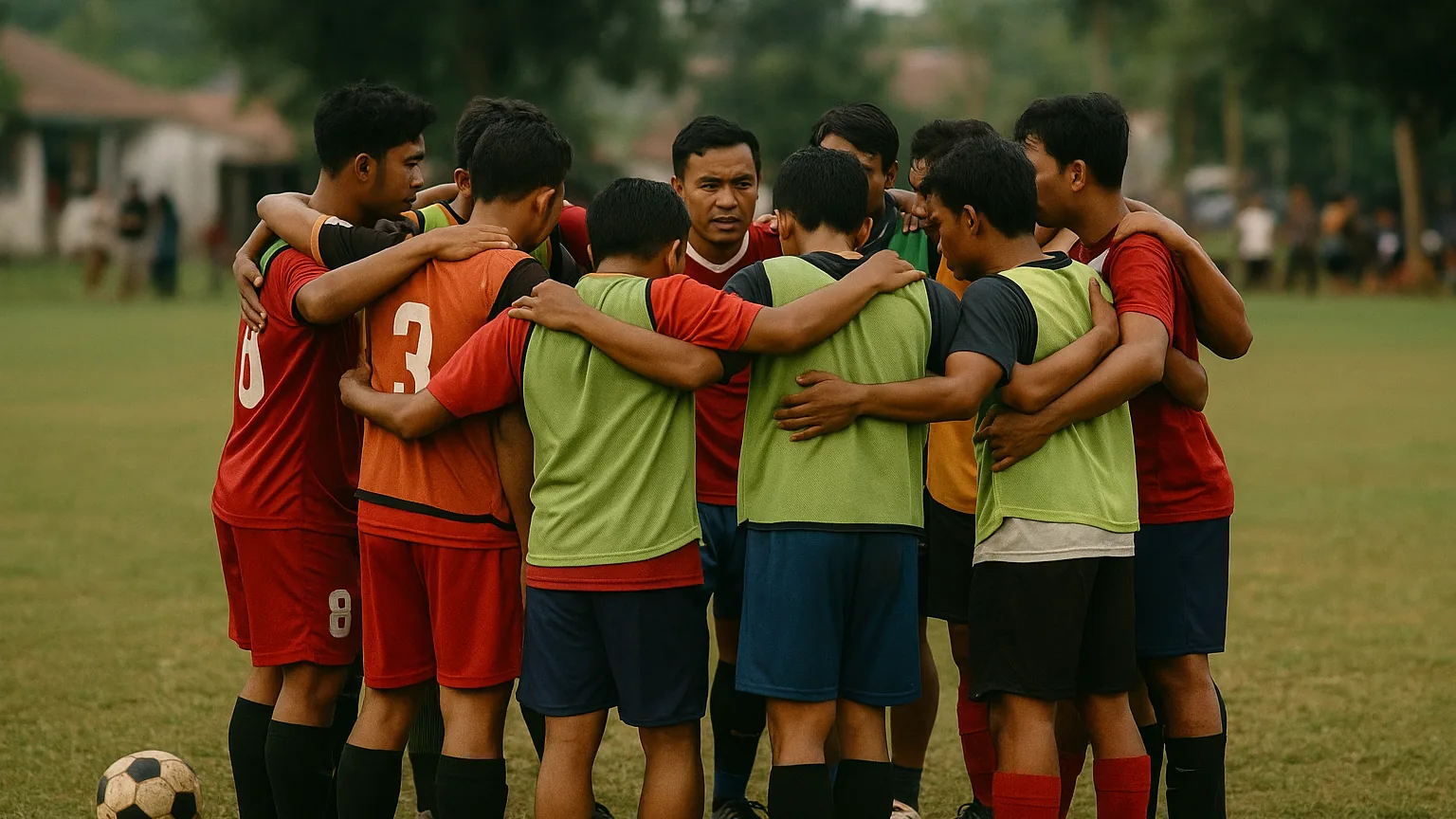
Once you've got a squad that trains and a pitch you can book, the natural next want is games against other teams - and the right first version of that is friendlies, not a league. A tanding persahabatan or uji coba against another kampung side is one of the easiest things in Indonesian football to arrange: a couple of messages in the right WhatsApp groups, a handshake over a shared pitch cost, and you've got a fixture. They cost almost nothing, there's no commitment beyond the one game, and they do more to pull a new squad together and pull new players in than anything else you can do, because a real match against real opponents is simply more fun than another training drill. Rack up a good run of those - twenty or thirty games of being a reliable side that shows up with eleven players and pays its half of the pitch - before you think about anything more formal.
A league or a turnamen (the Agustusan cups, the local competitions) is a fine ambition, but it's a big step up in organising, and it's worth being clear-headed about the extra load before you sign up. Leagues mean registration fees, fixed fixtures you can't move around work and weddings, referees to pay, a squad you have to guarantee every single week for months, and usually a more formal player registration than friendlies ever needed. That's all manageable once the club is solid, and it can be brilliant for giving the season a shape and something to play for. But a club that jumps into a competition before it can reliably field a team just ends up conceding walkovers and deflating everyone, so earn it first. Be a good friendly side that never lets its opponents down, and the league will still be there when you're ready for it.
The short version: lock in a regular pitch before anything else and treat it as your one unavoidable cost, keep the schedule simple and the fixtures early, buy dull gear before flashy kit, hold a squad list with emergency contacts and a stocked first-aid kit, set subs that actually cover the pitch every week, and start with friendlies long before a league. The general club basics still apply on top of all this - this is just the extra layer sport adds.
The bit that tends to bite a sports club soonest is the money side, precisely because the pitch bill is relentless - you're tracking who's paid this week across a shifting squad, chasing the three who "forgot", and quietly covering the gap yourself when the sums don't land. That weekly grind is exactly what Anggota is built to take off your hands - a squad list, subs and payments and the group all in one place, so you can see at a glance who's paid and who's due before the pitch bill lands, free to start. But plenty of good tarkam sides run happily on a QRIS code and a group chat for a long while first, and if you'd rather take these ideas and run them through whatever you already use, that's genuinely fine - the principles hold either way, whether you're building the next big club in the neighbourhood or one that never becomes more than a very good Sunday. And if you're weighing whether to formalise as your side grows, the longer guide on starting a membership organisation covers the governance side when you get there. Above all, good luck with it - your kampung could do with one more team that actually turns up every week, and somebody has to be the one who finally organises it.