
Member engagement ideas that actually stick
A practical, grouped set of member engagement ideas - regular rituals, real roles, communication that isn't spam, honest recognition, and community both online and in person - with straight talk about what works and what quietly burns your volunteers out.
Engagement is one of those words that gets stretched until it means everything and therefore nothing. People use it for email open rates, for app logins, for how many likes a post got, and by the time you've finished nodding along you've lost the plain thing underneath, which is simply this: are your members actually taking part, or are they just names on a list who happen to still be paying? A member who turns up, joins in, chips into the group chat, brings a friend along, runs the occasional thing - that member is engaged, and you can feel it without measuring anything. A member who joined eighteen months ago and hasn't been seen since is not, whatever the spreadsheet says about their subscription still being active.
It's worth being clear about how this sits next to two things it gets muddled with. This article is a companion to the bigger guide on retention, and I won't rehash that here - retention is the outcome (people staying), and engagement is a big part of how you get there, but they aren't the same word. It's also not the same as your list of member benefits. Benefits are what you offer - the discounts, the events, the members' area. Engagement is whether anyone actually does anything with them. You can have a generous list of benefits and a room full of people quietly disengaging, which is a strangely common and quite deflating combination.
So the useful question isn't "how do we boost engagement" - which sounds like something you'd buy - but "what are the small, repeatable things that get members doing rather than just belonging, and which of them can we actually keep up". That last part matters more than it looks, because the graveyard of member engagement is full of brilliant ideas that ran three times and then quietly died the moment the one person holding them up got tired. Repeatable beats flashy nearly every time, and most of this article is really an argument for that.
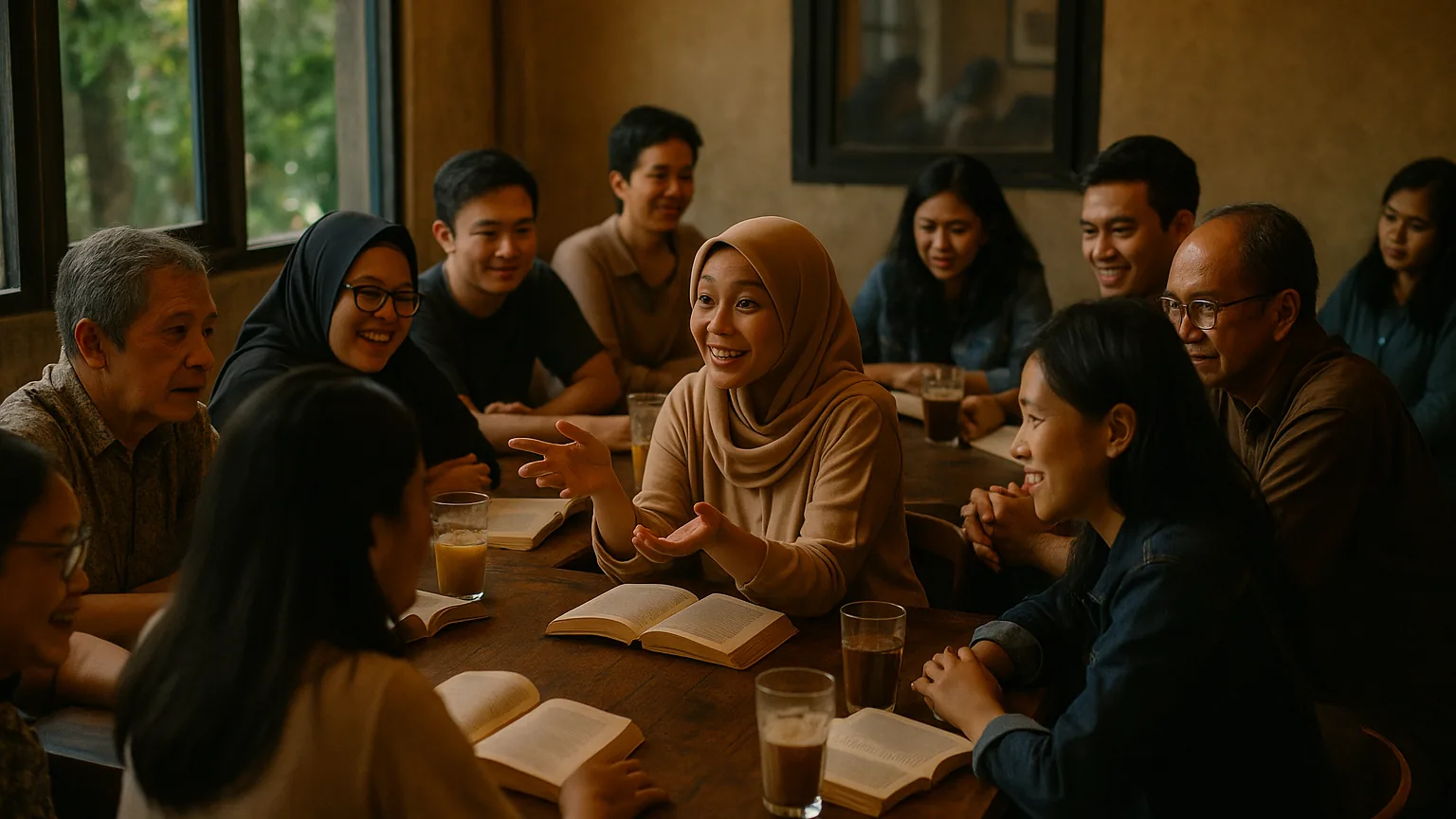
Let me run one example through the whole piece to keep it honest. Say you help run Klub Buku Senja, a reading community in Bandung - around 140 members, a monthly discussion in the back room of a cafe, an active WhatsApp group, and the occasional evening with a visiting author. On paper it looks healthy. But if you look closely, the same 15 to 20 faces come to every discussion, the group chat is carried by a handful of people, and most of the organising lands on Dewi, who has been doing it more or less alone for two years and is, though she'd never say so out loud, getting close to done. That's a very ordinary picture, and nearly everything below is about spreading that load and widening that circle without turning any of it into a second job.
Build engagement on regular rituals, not big events
The single most reliable engagement tool is a regular thing that happens whether or not anyone feels inspired that week. A ritual - the monthly discussion, the weekly run, the first-Friday meetup - does something a one-off spectacular can't: it lets people plan their lives around it, and it keeps turning up in their calendar as a small, low-effort yes. Klub Buku Senja's monthly discussion is already exactly this, and it's worth recognising it as the backbone rather than as something ordinary to be improved upon. The temptation, always, is to assume engagement means doing something bigger and newer. Usually it means doing the same modest thing, reliably, for long enough that people build it into who they are.
The honest tradeoff is that rituals are a bit boring to run. The tenth monthly discussion is nowhere near as exciting to organise as a shiny new format, and this is exactly where a lot of communities come unstuck - they get restless, chase novelty, and let the steady thing wobble because it stopped feeling special to the organisers (never mind that the members still loved it just fine). My rule of thumb is to protect the ritual first and add novelty around the edges, not the other way round. If the monthly discussion is solid, an occasional author evening on top of it is a lovely bonus. If the monthly discussion is flaky, no amount of special events will paper over the crack.

Give members a role, not just a seat
People stay involved in things they help run. This is probably the most under-used engagement idea there is, and it's the one that does double duty, because every role you hand out is both a member who's now far more attached and a job that's no longer sitting on Dewi's shoulders alone. The move is to soften the invisible wall between "the organisers" and "the members", so that taking part shades gradually into helping out, rather than being a sudden terrifying leap onto a committee.
At Klub Buku Senja that could be rotating who leads each month's discussion, so it isn't forever the same voice - a different member picks the book and runs the conversation, which spreads both the work and the sense of ownership. It could be one person who curates the reading list, another who looks after welcoming newcomers at the door, someone who keeps the group chat ticking over. The key, and I'd underline this, is that these should be real roles with a bit of genuine ownership, not chores dumped on whoever didn't step back fast enough. "Can you run the July discussion, pick something you love" is an invitation. "Can you stack the chairs afterwards" is not. One builds engagement; the other quietly teaches people that helping out means being taken advantage of.
Be ready for this to feel a little uncomfortable at first, and slower than just doing it yourself - handing over a job you're good at means watching someone do it differently, sometimes less well, and biting your tongue while they find their feet. It's worth it, because a community where only the founders ever run anything has a hard ceiling on how big and how durable it can get, and when they burn out (and they will), the whole thing tends to go with them.
Communicate like a person, not a broadcaster
Communication is where engagement is quietly won or lost, and where good intentions do the most damage. The instinct, the moment you decide to "engage members more", is to send more - more emails, more reminders, more posts - and it usually backfires, because the fastest way to train someone to ignore you is to message them constantly about things that don't concern them. Every irrelevant message spends a little of the attention you'll badly want later, and once someone has mentally filed you under "noise", they stop reading the important ones too.
The version that works is less, but better aimed. For most communities that means one channel that's genuinely alive - for Klub Buku Senja, the WhatsApp group - plus a short, dependable note about what's coming up, so nobody has to go hunting to find out when the next discussion is. What makes a group chat engaging isn't volume, it's that real conversations happen there and a human keeps it warm, nudging it along when it goes quiet and steering it off the rocks when it gets tetchy (every group chat gets tetchy eventually). There's a genuine tension to sit with here: a lively chat is engagement gold, but it can also tip over into the kind of endless notifications that make people mute the group, which is disengagement wearing a busy costume. Err on the side of quality over quantity, and treat your members' attention as something you're borrowing rather than something you own.
A quick test for any message before you send it: would you be glad to receive this if you were a fairly casual member, not a committed one? If it's genuinely useful or genuinely warm, send it. If it's really there to make the organisers feel active, it's costing you more attention than it's worth. The casual members are the ones on the edge of drifting off, and they're exactly the ones a steady drip of low-value messages pushes over the edge.
Recognise people, but mean it
A little recognition goes a surprisingly long way, because most people contribute to communities partly to be seen doing it - not in a vain way, just the ordinary human wish to have your effort noticed by people whose opinion you care about. Thanking the member who led this month's discussion, marking someone's first year, a genuine shout-out in the group when a member does something good - these cost nothing and they quietly fuel more of the behaviour you want to see. Recognition is about the cheapest engagement tool going, and one of the most neglected, probably because it feels too small to bother with.
The catch, and I've watched this go wrong more than once, is that recognition only works when it's real. A heartfelt "thanks Dewi, that was a great discussion, we'd be a bit lost without you" lands. An automated badge, a points tally, a system that congratulates everyone identically for logging in - that curdles fast, because people can tell the difference between a person noticing them and a machine performing the motions of it. So keep it human and keep it specific. Recognise the actual thing the actual person did, and resist the urge to systematise it into something that scales but means nothing. This is engagement, not gamification, and the two are further apart than the software vendors would like you to believe.
Let the online and the in-person feed each other
Most memberships live in two places now - the room where you meet and the screen where you talk between meetings - and the mistake is treating them as rivals, or picking one and neglecting the other. They work best as two halves of the same thing. The in-person gathering gives the online space something real to be about, and the online space keeps the warmth alive across the three or four weeks between gatherings, so people arrive at the next one already mid-conversation rather than starting cold. Klub Buku Senja's chat is livelier in the week after a discussion precisely because everyone was just in a room together, and the next discussion is better attended because the chat kept the book (and the plans) alive in between.

Which to lean on depends honestly on your members, not on what's currently fashionable. A community spread across several cities may live mostly online out of necessity; a tight local group may barely need the chat because they see each other anyway. In my experience the pure versions are the fragile ones - online-only communities tend to fade into a dead channel nobody posts in, and in-person-only ones quietly shut out everyone who couldn't make it that night. You don't need both to be elaborate. You need both to exist, even modestly, so there's always a way to take part whether or not you could be in the room on a given Tuesday.
What burns volunteers out, and what to do instead
Now the honest part, because engagement ideas have a dark side nobody puts on the flyer: nearly all of them run on volunteer energy, and volunteer energy is not infinite. The most common way community engagement collapses is not that the ideas were bad - it's that two or three committed people quietly carried everything until they couldn't, got tired or resentful or simply busy with the rest of their lives, and stepped back, taking the meetups and the chat and the momentum with them. Dewi doing everything at Klub Buku Senja is not a sign of a healthy community. It's a risk dressed up as a strength.
A few things burn people out fast, and they're worth naming so you can catch them early. Over-programming is the big one - deciding that more engagement must mean more events, and scheduling a frantic calendar that exhausts the organisers long before it exhausts the members (who were perfectly content with once a month). The hero-organiser pattern is the next - everything depending on one person, so they can never take a break without the whole thing stalling. And chasing every clever new suggestion is the quiet one, until the load is unmanageable and nothing gets done properly. The antidote to all three is the same, and it's the least glamorous advice in this article: do less, spread it wider, and make it repeatable. A community that reliably does one modest thing a month with the work shared across eight people will comfortably outlast one that does something dazzling every fortnight on the back of a single exhausted volunteer.
The question to keep asking isn't "what else could we do to engage members" - it's "what are we already doing that works, and how do we make it survive the people currently holding it up".
Start small, and only add what sticks
You do not need to launch an engagement programme. Pick one or two of the ideas above, do them properly, and watch what actually takes. For Klub Buku Senja the first moves wouldn't be new events at all - they'd be rotating the discussion leader so Dewi isn't always the one on, and giving one other person clear ownership of the welcome for newcomers. Two small changes, both of which spread the load and deepen a couple of members' involvement, and neither of which needs a budget or a launch night. Once those are steady, you add the next thing, and not before.
And test the cheap version first. Before committing to a monthly members-led session, try it once and see whether anyone actually wants to lead. Before assuming the community is gagging for more events, ask them - a two-line message ("what's the best thing about being part of this, and what's one small thing you'd love us to do") will tell you more than an afternoon of the committee guessing. Build for the members you've actually got, keep whatever they genuinely use, and let the rest go without mourning it too much….
If you take one thing away: engagement isn't a campaign you run, it's a set of small, repeatable habits that get members doing rather than just belonging - a reliable ritual, real roles to hold, communication that respects people's attention, honest recognition, and a community that lives both online and in person. Keep them modest enough that they survive the people running them, and they'll do far more than any flashy one-off ever could.
A fair bit of this is what Anggota is built to take the friction out of - a members' area that gives people somewhere to actually take part rather than just be billed, records so you can see who's turning up and who's gone quiet, and the ordinary admin handled so the volunteers holding your community together can spend their energy on people rather than paperwork. If that sounds useful you're welcome to try it for free and see how it fits. And if you'd sooner take these ideas and run them through whatever you already use, that's genuinely fine too - none of this depends on a particular tool, and a community where members actually take part is worth building however you get there.