
Your event planning checklist - every job, in the order it needs doing
Every job from six months out to the thank-you emails after the doors close, written for a volunteer committee rather than a hotel events department. Budget shares, an access checklist, and a plan for when something goes wrong.
Most event planning guides you'll find were written for a hotel with a full-time events department - paid staff, a huge budget, someone whose actual job this is. Your organisation has a treasurer who does the books after work, a WhatsApp group, a spreadsheet somebody built three years ago, and a committee that would like to know why this year's event isn't simply like last year's, except the person who ran last year's moved to Surabaya in March and took the whole thing in their head with them. This guide is written for that situation instead. It's ordered the way planning actually happens, which is by when a job needs doing rather than by who does it.
I'll carry one organisation through the whole thing so the numbers stay honest. Say you help run Persatuan Drumband Bahana Wijaya in Semarang - 26 member groups, mostly school marching bands with a few community ones, about 900 performers between them. Once a year the persatuan runs its open competition: a full day at a sports hall, roughly 600 performers taking part, twelve or thirteen hundred people watching once you count families, a panel of judges brought in from out of town, and a budget of somewhere around Rp 85 juta. It is easily the biggest thing the organisation does all year, and it is the thing most likely to quietly exhaust the committee.
If you're still deciding what sort of event to run in the first place, that's a different question and I've written about it separately in which events are actually worth running. This one assumes you've decided, and starts from there.
Prefer it on paper? There's a nine-page printable version of everything below (designed to be written on rather than admired), with blank columns for who's doing each job and when it's due, plus the access checklist and the what-if-something-goes-wrong page. Download the PDF checklist.
Agree what the event is for, before you look at a single venue
The most expensive mistake in this whole process happens in about the first fortnight, and it happens quietly. The committee agrees it wants to run an event, everybody pictures something slightly different (nobody says so, because it all sounds like agreement), and somebody starts ringing venues. Three months later you find out that half the committee thought this was about raising money and the other half thought it was a day for the members, and those two things want different venues, different prices and different amounts of time to prepare.
So settle that first. The thing worth noticing in the table below is that the time you need grows much faster than the number of guests does. An event for 400 people isn't simply a bigger version of one for 60, because finding sponsors, meeting the caterer's minimum order and sorting out prizes all take their own time on top of finding a venue.
| Type of event | Usual size | Start planning | Mainly for | What catches people out |
|---|---|---|---|---|
| Members' get-together or kopdar | 15 – 60 | 4 – 6 weeks ahead | Keeping members involved | Not telling members properly, as though they'll simply know |
| Workshop or training day | 15 – 75 | 6 – 8 weeks ahead | Giving members something useful | A room that fits everyone sitting down but not doing the activity |
| Fundraising dinner | 100 – 400 | 4 – 6 months ahead | Raising money | Sponsors and prizes take longer to sort out than the venue does |
| Competition or annual conference | 150 – 1,000+ | 6 – 9 months ahead | Reputation, money, keeping members | Judges, officials, and fitting everything into one day |
| Annual general meeting | Varies | 2 – 3 months ahead | Formal decisions | How much notice your own rules say you must give members |
Bahana Wijaya sits in that fourth row, which in practice means six to nine months rather than the four the committee usually assumes back in January, when the whole thing still feels comfortably far away.
Write down two or three numbers you'll check afterwards
"Make it a success" is a feeling rather than a goal, and the trouble with feelings is that they cannot settle an argument in December about whether the thing actually worked (an argument almost every committee ends up having). So before you book anything at all, write down two or three numbers you will genuinely go back and look at afterwards. Two is usually plenty, and three is about the most I would attempt (four and you will quietly stop checking any of them).
| What you're checking | A target that means something | How you'll know |
|---|---|---|
| How many turned up | 85% of the people who signed up actually came | Count people at the door, compare to the sign-up list |
| Money | Covers its costs and leaves Rp 15 - 20 juta over | Everything in, minus everything out, added up within a fortnight |
| New members | 15 – 25 people joined on the day | Note down who joined at the event, rather than guessing later |
| Members staying on | 70% of groups whose fees are due pay within a month | Check who renewed against who came |
| Whether people enjoyed it | Average score of 4.3 or better out of 5 | A short survey sent within two days |
Pick two or three from that list rather than attempting all of it, because in practice they pull against each other: paying for better food makes everybody happier and leaves less money at the end, and a committee trying to do well on turnout, money, new members and enjoyment all at once will usually manage none of them properly. For Bahana Wijaya the two that matter are the money left over at the end (because that is what funds the following year) and how many member units pay their fees in the weeks afterwards, which is the one nobody ever thinks to check and is quietly the one that tells you whether the competition is doing its real job.
Work out the budget, then put some of it aside and don't touch it
The usual budget failure is not spending too much on any one thing, it is failing to keep anything at all back for surprises. Work out what everything costs, then set aside 10 - 15% of the budget for unexpected costs and simply don't assign it to anything (which takes more discipline than it sounds). That is the money that quietly covers the caterer putting their price up, the sound hire coming in over the quote, the printer who got the price wrong, and the extra shelter you had no idea you needed until the forecast changed on the Thursday.
Below is a starting point for a medium-sized event, worked through on Bahana Wijaya's Rp 85 juta. Treat it as somewhere to start the argument rather than as a rule handed down from anywhere, because a workshop with no meal service will shift most of that food money across to the programme instead.
| Where the money goes | Share | Out of Rp 85 juta |
|---|---|---|
| Venue hire and food | 38% | Rp 32,3 juta |
| Sound, staging, signs and crew | 18% | Rp 15,3 juta |
| The programme itself - judges' fees, trophies | 16% | Rp 13,6 juta |
| Telling people about it and taking sign-ups | 14% | Rp 11,9 juta |
| Set aside for unexpected costs | 14% | Rp 11,9 juta |
Protect the money you've set aside. It stops being emergency money the moment somebody quietly spends it on a nicer backdrop in month three, which is more or less what always happens if nobody is guarding it. Put one person in charge of it, make anybody who wants to dip into it ask that person first, and expect that in a good year you will finish up with most of it unspent - that is the fund doing exactly its job rather than money you wasted, however it looks on the final spreadsheet.
What to do, and when
Eight stages, from the first meeting to the last thank-you. Put a name against each job before you move on to the next stage - a person's name, not "the committee" (a job owned by everybody is owned by nobody). The most reliable warning sign of an event going wrong is a job everybody agrees is important and nobody has their name against.
Four to six months ahead - making decisions
Everything at this stage gets harder and more expensive to change later on, which is precisely why it is so tempting to skip past it and start doing something that feels a bit more like progress (booking a venue feels like progress; agreeing what the event is for does not, and yet it is worth ten times as much).
- Agree what type of event this is and the main thing you want out of it
- Work out a rough budget, including the spare money for surprises
- Pick two or three possible dates and check them against school terms, Ramadan and Lebaran, and anything else on in the same scene
- Choose one person to lead the whole thing, and one person to look after the money - one each, by name
- Visit at least three venues, and check in person that people who use a wheelchair can get in and around, rather than trusting the website
- Write out what sponsors get for their money, on a single page you can hand over
- Start asking judges, officials or speakers - the good ones get booked up early
- Decide what it costs to take part, and whether there's a cheaper price for booking early
- Decide now what you'll provide for guests with disabilities, so it goes into the venue contract instead of being sorted out in a panic later
- Book the venue and get it in writing, including what happens if you have to cancel
Book the venue before you announce the date. Announce first and book second and you will lose a fortnight telling everybody the date has changed, and the members you annoy most doing it are precisely the ones who were organised enough to write the first date down (ie your best people).
Three to four months ahead - getting everything agreed in writing
- Sign agreements with the caterer, the sound and staging company, the photographer and anyone doing decorations
- Confirm judges or speakers in writing, including what equipment they need and whether you're paying travel
- Finish the sponsor packages and start approaching sponsors
- Open sign-ups, with a space on the form where people can tell you if they need anything - a ramp, a special meal, a seat near the front
- Find somebody to organise the helpers, and start signing people up for slots
- Draft the event page, the emails you'll send, and what you'll post and when
- Order anything that takes a while to print - banners, backdrop, numbers, certificates
- Sort out permits and insurance with the venue and the local authorities
- Sketch out the plan for the day, hour by hour, so the caterer and the sound company can work around it
- Book anything you need for guests with disabilities - a ramp, reserved seats, a sign language interpreter if you're providing one
- Check the smallest order the caterer will accept, and how you'll collect people's food requirements
- Write the after-the-event survey now, while you still remember what you were trying to achieve
- Add up what you've spent so far, compare it to the budget, and say something if anything looks like going over
Six to eight weeks ahead - telling everybody
This is the stage where people vaguely hearing about it has to turn into people actually signing up, and the mistake almost everybody makes is waiting. Leave the push until a fortnight beforehand and discover the numbers are poor, and there is simply no time left to do anything useful about it - whereas the same bad news six weeks out is an entirely fixable problem.
- Send the first proper email about it to every member
- Put the details on your website, the members' area and your social media
- Personally invite the people who matter - committee members, past sponsors, well-known figures in your scene
- Chase up whatever the sponsors promised to post or share
- Check every week how sign-ups are going against your target, rather than once at the deadline
- Remind members whose fees are due soon, and point out the event is part of what they're paying for
- Push harder on finding helpers if less than 70% of the slots are filled
- If sign-ups are slow, decide now whether to extend the cheaper early price or do another round of promotion - deciding late is the same as deciding not to
Your own member list will bring in far more people than paid social media ever will. Lead with email, WhatsApp and simply asking people directly, and treat social media as backup rather than the main event. This is the one real advantage a membership organisation has over a commercial promoter (they would love to have your list and cannot buy it), and it is genuinely surprising how many committees ignore it in favour of paying to boost a post.
Two to three weeks ahead - the details
- Give the venue and the caterer a firm number, or as close as you can get
- Pull together everything people told you they need, from food requirements to wheelchair access
- Decide the layout, where people sit, and where the accessible seats actually go
- Confirm what time judges or speakers arrive, what equipment they need, and how you'll introduce them
- Print name badges, signs and anything else physical
- Put a name against every helper slot and send those people the plan for the day
- Send everyone who signed up a plain note about what to expect: where to park, what time, what to bring
- Confirm your backup plans and who to ring if something goes wrong
- Add up what you've spent and check the spare money is still untouched
One week ahead - check everything again
- Ring every supplier again. Phone, not email
- Check the weather and switch to your wet-weather plan if you need to
- Test the microphones, the sound, anything you're streaming, and the system you'll use to sign people in
- Print the plan for the day and give it to every helper, supplier and official
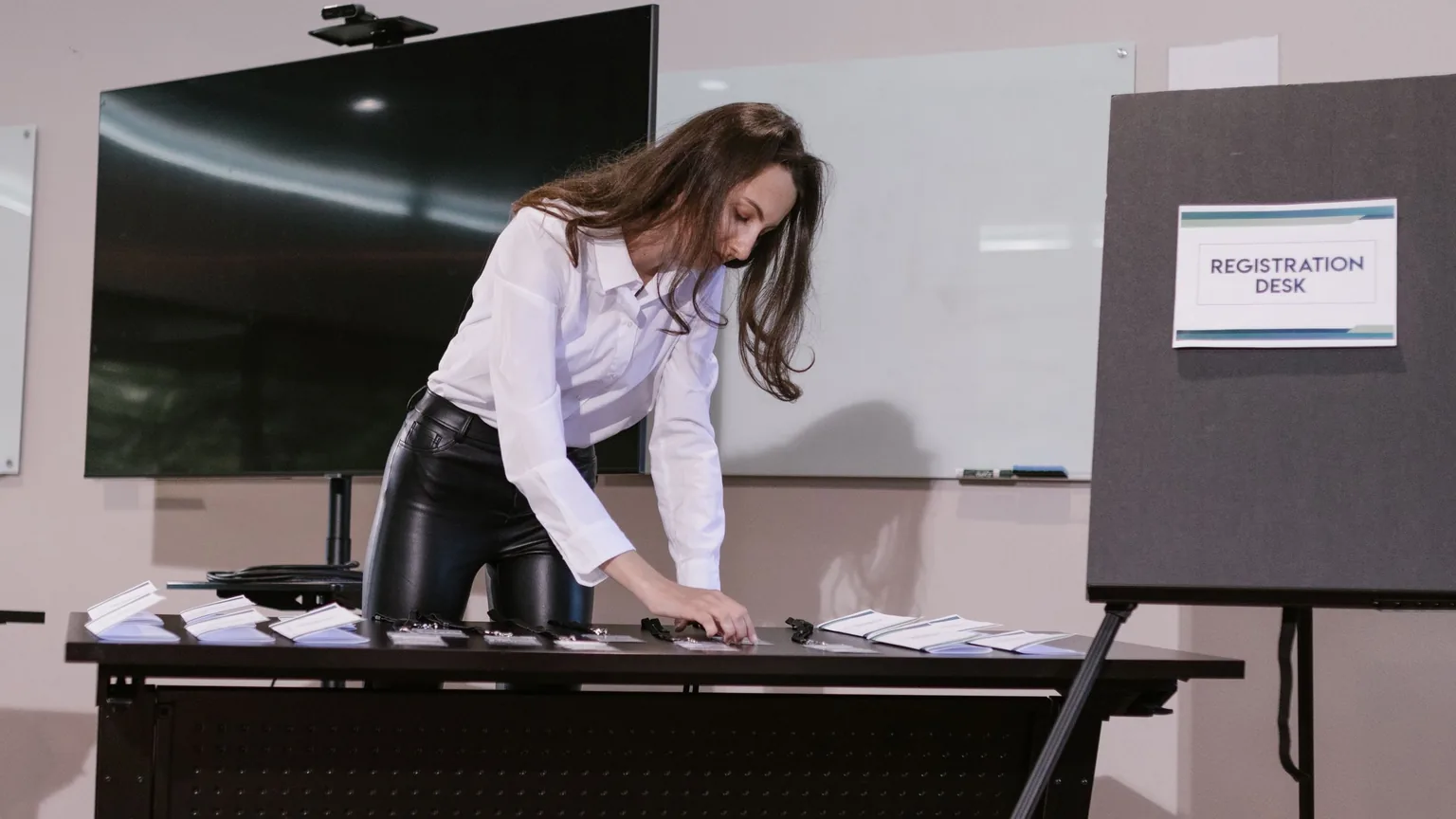
- Get the sign-in desk ready: lists, badges, and some change if you're taking cash
- Send the last reminder with any final details
- Pack the box of things you'll need on the day
- Agree who gets to make the call on the day if something goes wrong
"Check again" means a phone call. Somebody signing an agreement ten weeks ago tells you nothing whatever about whether the van is still booked for Saturday, and sending the email again tells you almost as little (a reply saying "yes all good" costs them nothing to type). Ring them, one at a time, and tick them off as you go.
The day before - walk around the venue
- Walk through the venue with the plan for the day in your hand, timing how long it takes to get from one thing to the next
- Check the step-free entrances, accessible toilets and reserved seats are genuinely clear and usable, and not blocked by the staging
- Put up the signs and the sign-in desk, and anything else that can go up early
- Test the sound properly, using the actual equipment you'll have on the day
- Confirm what time the caterer and the hire company are delivering
- Charge everything - microphones, tablets, card machines, phones
- Send the helpers a short "see you tomorrow" with the time to arrive and where to park
On the day
- Get there before the suppliers and the helpers, with time to spare
- Walk round one last time: entrances, signs, exits, toilets
- Brief the helpers face to face, about fifteen minutes before you open the doors
- Put enough people on the sign-in desk, and have a plan for when a queue builds up
- Give one person - not whoever is running the event - the box of emergency supplies and the job of dealing with problems
- Keep a count of who actually turns up, so you can adjust the food if you need to
- Take photographs, both for the thank-you email and for next year's promotion
- Sign up new members and collect fees on the day, not "afterwards"
- Get the core team together for ten minutes as soon as the doors close, while everyone still remembers
One person changes the schedule. Just one. When three people can all make the same decision you get three different answers, and you generally get them in the ten minutes of the day you can least afford it. Say out loud, at the morning briefing, who that person is.
Afterwards - the two weeks that decide whether it was worth it
- Thank-you emails within two days: everyone who came, the sponsors, the officials, the helpers
- Send the survey within two days as well - five questions, no more
- Pay the bills that are still outstanding and add up what it all actually cost
- Give the committee the real numbers: who came, what was left over, new members, survey score
- Follow up one by one with new members and with anyone wavering about paying their fees
- Return anything you hired and chase up the deposits
- Write one page of notes while you still remember: what to do again, what to change, what to drop
- File the plan for the day, the supplier phone numbers and the budget somewhere you'll find them next year
Bigger or smaller than that
The eight stages above are pitched at a medium-sized event. If yours is smaller or larger the stages themselves don't change, but how early you need to start certainly does, and that is the bit people consistently underestimate.
| Size | What that looks like | Start at least this far ahead |
|---|---|---|
| Small | Workshop or get-together, under 50 people | About 5 weeks |
| Medium | Fundraiser or competition, 50 – 250 people | About 3 months |
| Large | Big dinner or multi-day event, 250+ people | About 7 months |
For a small event, roll the first two stages into one four to six week push and skip sponsors altogether (the selling costs more than the sponsorship is worth) - the work of selling a Rp 2 juta sponsorship rarely pays for itself on a workshop for fifty people. For a large one, stretch the first stage out to eight or ten months, because at that size what holds you up stops being your own preparation and becomes whether the venue and the judges are free at all.
The two-week check
A fortnight out, you should be able to look at where things stand and tell within a minute or two whether this is under control or about to become a scramble. It comes down to about four things on each side.
| Under control | About to become a scramble |
|---|---|
| Sign-ups are within about 10% of your target | You're still "waiting to hear back" from a supplier booked months ago |
| Every supplier has confirmed within the last fortnight | Nobody has actually agreed to run the sign-in desk |
| 90% of helper slots have a name against them | Nobody has compared spending to the budget since the first meeting |
| You could hand the plan for the day to a stranger and they'd manage | There's no answer to "what if it rains" |
Questions worth asking the venue
Beyond the obvious question of whether everybody fits in the room (which is the only one most groups ask), these are the ones that cause real trouble on the day when nobody thinks to ask them beforehand.
- Can someone get in the main entrance without using steps, and is there an accessible toilet on every floor you're using?
- What time can you get in to set up, and how wide is the delivery door? Measure it if you're bringing staging or large instruments
- Is there a backup generator, if you're running a lot of sound or lighting?
- Can you bring in your own caterer, and is there a time you have to stop making noise?
- How many parking spaces, and where's the nearest bus or train stop that a wheelchair user can actually use? You'll want this for the invitation
- What happens if you cancel, or if the weather turns? Get it written into the agreement rather than promised verbally
- Who is the person at the venue on the day, and what's their mobile number?
- Is the wifi good enough to run card payments, sign-ins or a live stream on?
Ask to see the delivery door as well as the hall. The nicest venue in the city turns into a nightmare if your caterer has to carry everything up a fire escape, and you will never find that out from the brochure or from a tour that politely walks you round the front of the building (always ask to go round the back).
Getting people to come
For a membership organisation the biggest asset by a distance is your own member list, and it is worth treating it that way rather than as an afterthought tacked on behind social media. The practical side of taking sign-ups and payments I have covered properly elsewhere - see running member event registration for how to set it up, and selling tickets to members for what to charge - so what follows is only the telling-people half of it.
- One page about the event with the date, the price, and a space to say what you need
- A run of emails: save the date, then the announcement, then reminders at four weeks and one week, then a last call
- Send different messages to different people - somebody who joined last month and somebody who's been in for fifteen years are not persuaded by the same thing
- A cheaper price for booking early, mostly so you find out sooner roughly how many are coming
- At least one post using photographs from last year, if you have any
- Send sponsors their logos and suggested posts at least six weeks ahead, or they won't get round to using them
- A confirmation email that contains everything somebody actually needs on the day
- A weekly look at how sign-ups are tracking against target, starting the day you open them
Worth knowing that a fair number of people who sign up won't turn up, and the gap is much bigger for free events than paid ones. I've written about that separately in the people who said yes and didn't come, because it's a problem of its own and it plays havoc with catering numbers.
Helpers
- One person in charge of the helpers, and not the same person running the event
- Ask people to sign up for a slot with a real start and finish time, rather than "come when you can"
- Line up a few more people than you need, because some will drop out
- Write down what each job involves: sign-in desk, greeting people, directing traffic, helping with sound, clearing up
- A group chat for the day, set up and tested beforehand rather than created that morning
- Badges or something visible, so guests can tell who to ask
- Thank them within two days - helpers who feel appreciated come back next year, and that solves most of next year's recruiting problem
Ask people to take a named slot rather than to "help out". Somebody who has agreed to two hours on the sign-in desk from eight until ten turns up nearly every time, whereas somebody who vaguely offered to help at some point turns up when they feel like it, which in my experience is rarely seven in the morning.
Making sure everyone can actually take part
"Think about accessibility" is not really a job at all, it is a note reminding you to do one, and it was comfortably the most commonly skipped item in every event guide I read while putting this together. What it actually breaks down into is the list below. Not all of it will apply to your event, and some of it costs money you may simply not have this year, but the difference between a group that has thought about any of this and one that hasn't is obvious to a guest from the car park onwards.
- Getting in and moving around: a way in without steps, an accessible toilet on each floor you're using, and reserved seats with a decent view rather than pushed to the back
- Following what's happening: subtitles on screen or a sign language interpreter for the main part of the day, booked at least a month ahead because there aren't many of them
- Asking people in advance: a space on the sign-up form to tell you what they need, checked every week rather than discovered the night before
- Somewhere quiet: a room away from the speakers, which at a marching band competition matters more than most places, and lights you can turn down if the venue lets you
- Printed material: large-print programmes for anyone who asks, and a version on the website that a screen reader can read aloud
- Food: ask specifically about allergies and dietary needs, and check the answers against the caterer when you give the final numbers rather than assuming it's handled
What if something goes wrong
Every plan wants a short and specific answer to "what do we do if" for each of the handful of things that realistically go wrong, worked out in a quiet room months beforehand rather than invented at six in the evening with guests already coming through the door (the quality of decisions made at that hour is not high).
| What might happen | When you check | What you already decided |
|---|---|---|
| Bad weather, if you're outdoors | Three days before | An indoor backup already written into the venue agreement |
| A judge or speaker pulls out | Any time | A reserve found back at the start, and told they're the reserve |
| The sound or the tech fails | Setup, or during the day | A spare microphone, and a printed schedule so the day can carry on without any sound system at all |
| Sign-ups under 60% of target two weeks out | Two weeks before | An agreed extra push, and a smaller room to fall back on |
| A supplier cancels at short notice | Any time | The list of other quotes you kept from when you first shopped around |
| Costs eat into the spare fund | Every bill | Spare money covers it first, and only the person in charge of the money approves anything beyond that |
The box you bring on the day: printed schedule and supplier phone numbers, a power bank, a basic first aid kit, spare badges and marker pens, tape, cable ties, some cash for the unexpected, and a printed copy of every agreement for the moment the wifi drops out and somebody disputes what was agreed.
The plan for the day
This is simply the day written down hour by hour on one sheet, and it is far and away the single piece of paper that does the most work on the day itself. Bahana Wijaya's is below, shortened a little - copy the shape of it and change the times to suit whatever you are running.
| Time | What happens | Whose job |
|---|---|---|
| 06.00 | Suppliers arrive and set up - sound, staging, food | Operations lead |
| 07.00 | Walk through the whole day with the venue contact and the sound engineer | Event lead |
| 07.30 | Brief the helpers - slots, where the emergency box is, who decides today | Helper coordinator |
| 08.00 | Sign-in opens, groups register and draw their performance order | Sign-in team |
| 09.00 | Opening, judges introduced, first performance | Person on the microphone |
| 12.00 | Break and lunch, served when the programme reaches it rather than at a fixed time | Operations lead |
| 13.00 | Afternoon session | Person on the microphone |
| 16.00 | Judges decide, sponsor thank-yous fill the gap | Person on the microphone |
| 16.45 | Results and prizes - name the sponsors and helpers out loud | Chair |
| 17.30 | Finish and pack down, ten minutes with the team before anyone goes home | Event lead |
Afterwards, which is the bit most groups rush
The event is not finished when the doors close, it is finished when you have followed up with everybody who mattered and turned the result into a decision about next year, and this is the part that almost every organisation short-changes because by then everyone is exhausted. It is also precisely why committees keep asking "did that actually work?" year after year and never quite manage to get an answer.
Thank-you email to everyone who came within a day, with a photograph in it. Survey within two days, five questions and no more: how much did you enjoy it, would you come again, one thing to keep, one thing to change, and has this made you more likely to stay a member or bring somebody next time. Personal thanks to every sponsor and official, ideally from a committee member rather than from whoever organised it. Individual follow-up with new members inside a week. Final tally and a report to the committee inside a fortnight.
Then write the one page of notes and file it with the budget and the plan for the day, because that is the bit whose value builds up quietly over the years. A committee that manages this three years running will plan its fourth event out of a folder rather than out of nothing at all, which saves whoever is organising it an enormous amount of work and, just as importantly, means the whole thing no longer lives in one person's head….
Take the printable version with you: all eight stages with blank columns for who's doing what and when it's due, plus the access checklist and the what-if page. Download the PDF checklist.
Quite a lot of the fiddly parts here - taking sign-ups and asking what people need, sending the reminders, keeping track of who has paid and who hasn't, who is helping and when, and the member list next year's promotion starts from - are what Anggota is built to take off your hands, so next year's folder fills itself instead of being rebuilt from scratch. If that sounds useful you're welcome to try it free. And if you'd rather run all of this on a spreadsheet and a well-organised WhatsApp group, that's genuinely fine too - plenty of very good events are run exactly that way every weekend, and none of the thinking above stops working just because you're keeping it somewhere else.